Maine
The Long WalkMaine is the geographical and emotional field through which Ray Garraty’s Long Walk acquires its most intimate meaning. It is his home state, the source of his identity as “Maine’s Own,” and the landscape in which family memory, local pride, public spectacle, state power, and physical collapse become inseparable. The route begins at the stone marker between the United States and Canada and proceeds south through Maine’s towns and infrastructure, making the state at once a homeland and a relentlessly measured corridor toward death.
Home State and Identity
Maine first appears as an administrative fact attached to Garraty’s identity. His blue plastic card records his name and address in Pownal, Maine, and identifies Androscoggin County, reducing home to data processed by a computer terminal in a guarded rural parking lot. The contrast is fundamental: Maine is a lived place of family and memory, yet the Long Walk’s authorities encounter it as an entry in a surveillance system. Garraty’s belonging is therefore registered before it is celebrated.
That belonging is publicly transformed into a slogan. Along the road, a sixteen-year-old girl holds up a sign reading “GO-GO-GARRATY NUMBER 47 We Love You Ray “Maine’s Own.”” The phrase gives Garraty a sudden emotional elevation; he feels that the unnamed girl has proved he will win. Maine becomes not merely a location but a role assigned by spectators, one that briefly converts private hope into collective expectation. The state’s identity is carried on a sign, performed for the crowd, and attached to a contestant whose body is already being consumed by the event.
Garraty’s connection to Maine is also expressed through ordinary conversation. When Arthur Baker asks whether he is from Maine, Garraty answers that he is from downstate. His reply places him inside a recognizable local geography even as the Walk strips away ordinary distinctions between hometowns, counties, and state regions. Later, when Peter McVries asks what follows Oldtown, Garraty names Bangor, Augusta, Kittery, and the state line, estimating roughly three hundred and thirty miles still to travel. His knowledge of the route is practical, but it also reveals how deeply the course has invaded his sense of place: Maine is no longer a home to return to, but a sequence of distances to survive.
The Route Through Maine
The Walk begins beside the stone post marking the border between the United States and Canada. At that threshold, Garraty’s anticipation briefly overtakes his fear. His mother gives him a foil-wrapped package of cookies, and he embraces her awkwardly before stepping back and putting the cookies into his fatigue-jacket pocket. The border thus carries two simultaneous meanings. It is the formal entrance into the competition and the emotional point at which Garraty leaves his family behind, carrying a small domestic gift into a militarized road space.
The Maine route is built from practical obstacles as much as from named towns. Near the sixty-mile mark, the walkers discover that a bridge has been damaged: one support and two heavy planks have been washed away. The Squad has erected a sawed-off telephone pole in the stream and substituted a convoy-truck tailgate for the missing bridge deck. This repaired crossing demonstrates how the Walk’s landscape is continually modified to preserve the event. Water, weather, and damaged infrastructure do not stop the competition; they become problems for the authorities to patch over so that the bodies can continue moving.
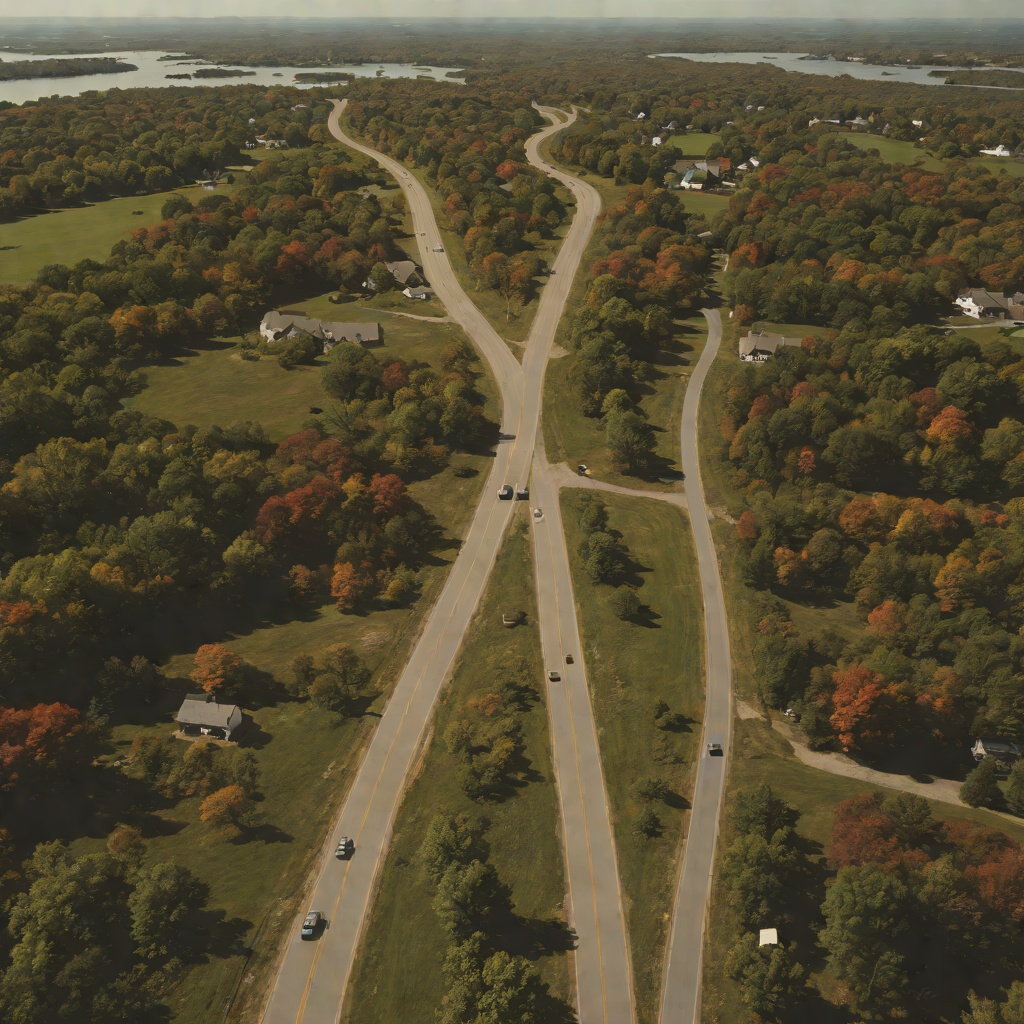
The route also follows major transportation corridors. Near Oldtown, the walkers switch through feeder roads, join Route 2, and pass through the town center around midnight. Later they parallel the turnpike, approaching an entrance ramp beneath bone-white arc-sodium lights. In Porterville, they pass the Recreation Center and a Government Sales building before walking beside the polluted Androscoggin River and crossing its bridge. These roads and bridges are not neutral scenery. They organize the walkers’ movement, separate them from traffic and spectators, and convert public infrastructure into a controlled track whose every mile can be counted.
By the time the walkers approach Freeport, Maine has become recognizably personal territory for Garraty. The route crosses the 295 overpass and enters town, turns onto U.S. 1, and leads toward Woolman’s Free Trade Center Market, where he has arranged to meet Jan and his mother. He remembers the Dairy Joy where he and Jan used to stop after movies, and the familiar road seems to accelerate as the meeting draws near. Yet the home landscape cannot restore ordinary life. The crowd swells, the fire siren joins Klingerman’s shrieks, and soldiers hold their guns ready as Garraty moves close to the grasping spectators. Familiarity intensifies the pressure rather than relieving it.
Towns, Crowds, and Public Spectacle
Maine’s towns repeatedly transform the Walk into a civic performance. At Caribou, a large crowd and a news crew surround the road under a battery of lights. A newspaperman in a three-piece suit trots beside the walkers with a long-reach microphone while technicians unreel electric cable. The state is therefore presented through media infrastructure as much as through forests, rivers, and roads: every locality can become a temporary studio and every exhausted walker a public object.
Caribou also exposes the disorder beneath the organized spectacle. A woman searching for Percy breaks through the police cordon and onto the road, pawing through the walkers and unintentionally tripping one of them. The soldiers reach for their guns, and a policeman finally restrains her and drags her to a cruiser. A small boy watches from a KEEP MAINE TIDY barrel while eating a hotdog. The scene compresses Maine civic life into a grotesque tableau of policing, family desperation, roadside branding, and casual spectatorship. Even a mother’s attempt to reclaim her son becomes an interference offense within the event’s rules.
At the hundred-mile point, a huge banner congratulates the walkers entering the “Century Club.” Collie Parker responds with contempt, while the first genuinely immense crowd erupts beyond the scattered stands of pine and spruce. State police hold people behind bright orange nylon ropes; flashbulbs burst; a policeman struggles with a screaming child carrying a toy glider and autograph book. Maine’s public face is thus divided between celebration and containment. The crowd claims emotional access to the walkers, but the ropes and armed authorities establish that the bodies on the road remain under institutional control.
Oldtown produces an even more overwhelming version of this public ritual. Around midnight, arc-sodium lamps turn night into a glaring, shadowless day, while confetti, newspaper scraps, telephone-book fragments, and toilet paper stream from upper windows. Garraty experiences the passage as a sleep-hazed nightmare, with cheering rising until thought and reason seem impossible. After the town, the crowd thins as the walkers follow the Stillwater River through morning, past the chemical and woodsmoke smell of the paper mill, polluted water, sawdust piles, and towering stacks of pulpwood. The celebration leaves behind an industrial environment whose material costs remain in the air and river.
Homecoming Denied
Maine’s strongest emotional reversal occurs in Freeport. Garraty expects Jan and his mother to be waiting in front of Woolman’s, and the final five miles seem charged with private anticipation. The arrangement turns the route into a projected homecoming: he is not simply approaching another checkpoint but the people and places that define his life outside the Walk.
The expected reunion is never secured by the evidence of the scene. As Garraty nears Woolman’s, he sees the brown sign but no familiar face. He drifts toward the crowd, where hands reach for him; one arm actually twitches the cloth of his shirt, and soldiers ready their guns in case he tries to vanish into the human surge. The physical geography of Maine has become hostile at the precise moment it should have offered refuge. The state’s roads lead him home, but the event’s crowd prevents home from functioning as a shelter.
This denial changes the meaning of Maine in the narrative. Earlier, “Maine’s Own” makes Garraty feel chosen, and the border crossing allows him to carry his mother’s cookies forward. At Freeport, however, the same public space absorbs and obscures his family. His disappointment becomes so severe that he wants to stop, not because the route has become unfamiliar, but because the familiar destination no longer promises recognition. Maine remains his state, yet the Long Walk has occupied its roads so completely that private belonging cannot displace public spectacle.
Toward the State Line
The state is not the final destination but the first large enclosure of the Walk’s geography. After the Maine towns and roads, the route approaches the narrow New Hampshire neck separating Maine from Massachusetts. A banner announces that only fifteen miles remain before the Massachusetts border. The sign reduces the political landscape to another countdown, just as Garraty earlier measured the distance to the state line at approximately three hundred and thirty miles from the northern route.
Maine’s narrative significance lies in this conversion of place into endurance. Its border marker, local signs, rivers, bridges, turnpikes, industrial towns, family meeting points, and crowds all remain concrete, distinct locations, but the Walk binds them into one relentless measurement. The state offers identity and memory while the competition offers only forward motion. By the time Garraty nears the Massachusetts border, Maine has been simultaneously homeland, stage, prison, and distance: the place that tells him who he is, and the route that makes that identity impossible to inhabit safely.